
How do we design for better multi-stakeholder collaboration?

Is your organisation convinced that working in isolation won’t lead you to success? Are you teaming up with organisations tackling similar societal challenges for greater impact? The excitement of launching a new initiative is encouraging: a university sharing research expertise, a government agency offering policy insights, and industry players providing market knowledge. There’s a common goal, tons of energy, and a rough outline of what needs to happen. Only later do you realise that organising this collaboration, and keeping the initial enthusiasm alive, is not so simple after all.
The hidden complexity of working together
Collaboration among multiple organisations is important for addressing complex challenges, but it is not without its difficulties. We want to highlight two issues that slow down this process and weaken initial momentum.
This differs from the clearly defined processes within a single organisation. In a multi-stakeholder collaboration, each partner brings their own work habits and preferences. If you haven’t worked together before, you find yourself leaning towards a mindset of “let’s just start and figure it out as we go”. Or, the organisation with the most resources imposes its preferred way of working, even if it isn’t suitable for cross-organisation collaboration. The need to thoughtfully organise and coordinate your collaboration is often overlooked, not necessarily out of ignorance, but because the right approach might not be clear.
Second, the lack of continuous communication poses a significant challenge since team members are often spread across different offices and primarily working remotely.Unlike teams that share an office, these already chaotic collaborations lack the natural flow of informal conversations that promote alignment. How often did you have a short discussion at the coffee machine to debrief and discuss the best way forward? Moreover, these initiatives are often secondary to regular work and receive limited time and attention. Communication becomes erratic and dependent on virtual interactions.
Collaboration needs to be designed, not just managed
Designing your collaboration requires more than just outlining clear roles and responsibilities or developing a project plan. How do we make sure all decisions are directly embedded in the process and visualised for current and new participants? How can participants provide feedback on the process or suggest modifications?
While traditional digital tools, such as Teams and Slack, provide communication options, they are insufficient for maintaining continuous alignment on the questions above. Stakeholders struggle to find the context and process in lengthy email threads, SharePoint folders filled with documents, and scattered post-it notes. For initiatives involving multiple organisations and rapidly changing circumstances, having a shared understanding of the big picture is crucial.
In the following section, we will share how Alkemio aims to support the organisation of multi-stakeholder collaboration, enhancing clarity and alignment among all participants.
How a digital environment can support you
While you still need dedicated tools, such as Word, PowerPoint, Miro, to do the work, we believe initiatives would benefit from adding a layer that allows you to organise and align on the work. Not static presentation or Excel with a plan, but a dynamic digital environment.
Alkemio’s Spaces provide a digital home for your collaboration, integrating essential elements such as:
- The hierarchy of the initiative is clearly displayed, showing who is leading or contributing to specific topics
- The processes and required steps are dynamically visualised, enabling stakeholders to communicate updates and suggest changes at each stage
- Work outputs (documents, brainstorm sessions, and event outcomes) are shared, allowing for feedback and discussions on the next steps
- New stakeholders quickly understand prior activities and identify where they can contribute
Reuse, adapt, and scale
A well-structured digital home doesn’t just keep your initiative organised and focused; it makes collaboration faster by turning previous successes into reusable assets. While consultancies may assist in designing your process initially, having a digital blueprint for your collaboration allows you to build on previous experiences. When starting your next project, you can reference what processes were followed, which roles were needed, and how actively each participant engaged.
Each time you refine your setup, you boost team efficiency and help stakeholders build familiarity and confidence. These templates can be reused across different projects, tailored to fit new goals, or shared with other initiatives facing similar challenges. Imagine being able to share a proven digital track record of your collaborations with other stakeholders? And a library that you can directly use for the next initiative?
Whether you need to manage a consortium and its work packages, align stakeholders within an innovation hub, or bring together startups and municipalities to co-create solutions, our library allows you to observe how similar initiatives have organised their work. These templates not only save time but also ensure your collaboration design is built on proven methodologies.
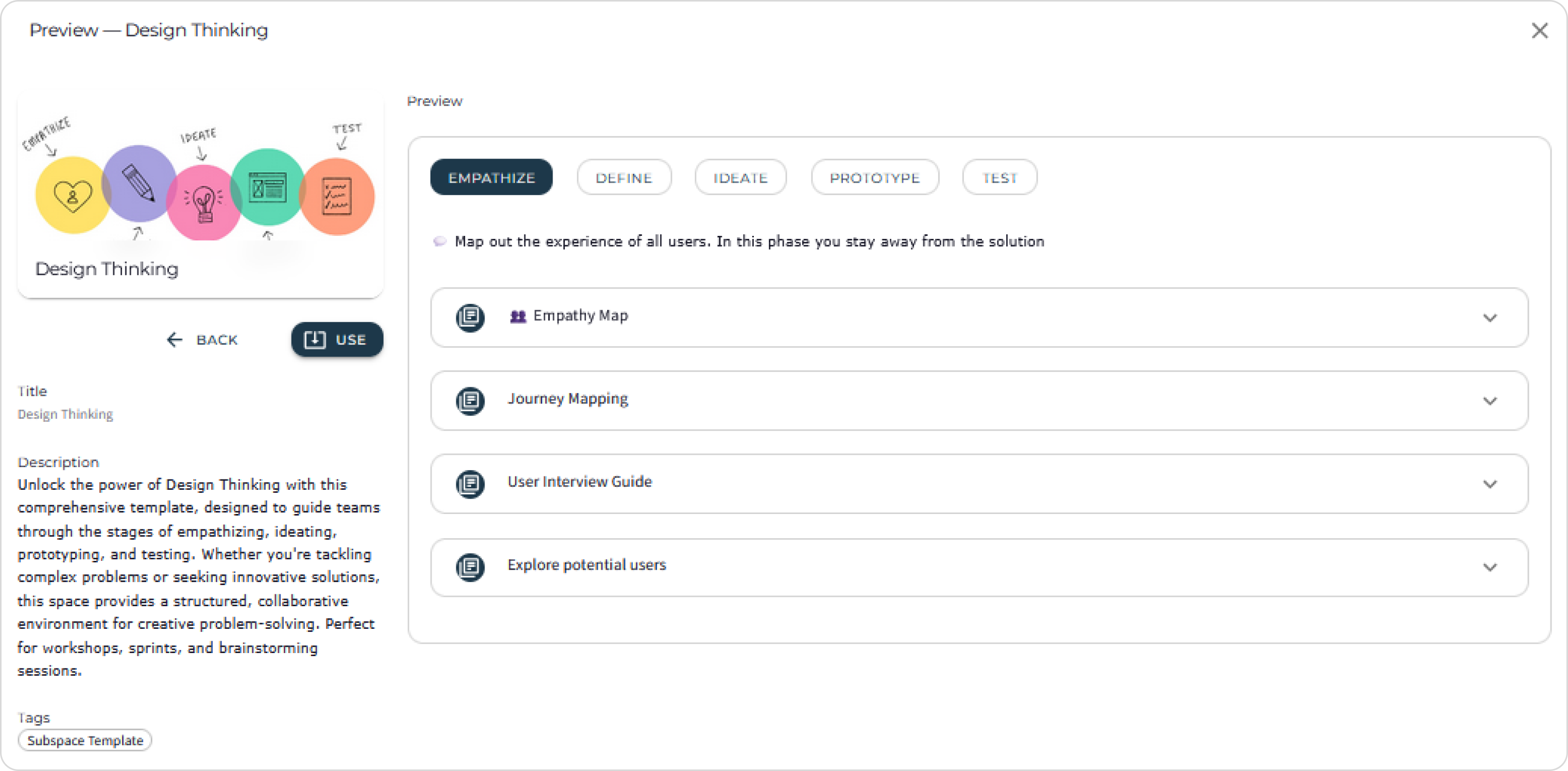
Templates that fit how you work
Multi-stakeholder collaboration can take many forms. To support this, we identified common scenarios and created templates tailored to each. Imagine starting a research consortium with a digital setup that directly has:
- Built-in places within the Space let you share updates, documents and events, so communication stays organised and accessible
- A dedicated Subspace and assigned lead for each work package is created, ensuring responsibilities are clear from day one
- Pre-configured workflows with steps and tools are set up within each Subspace to help you organise and coordinate the work
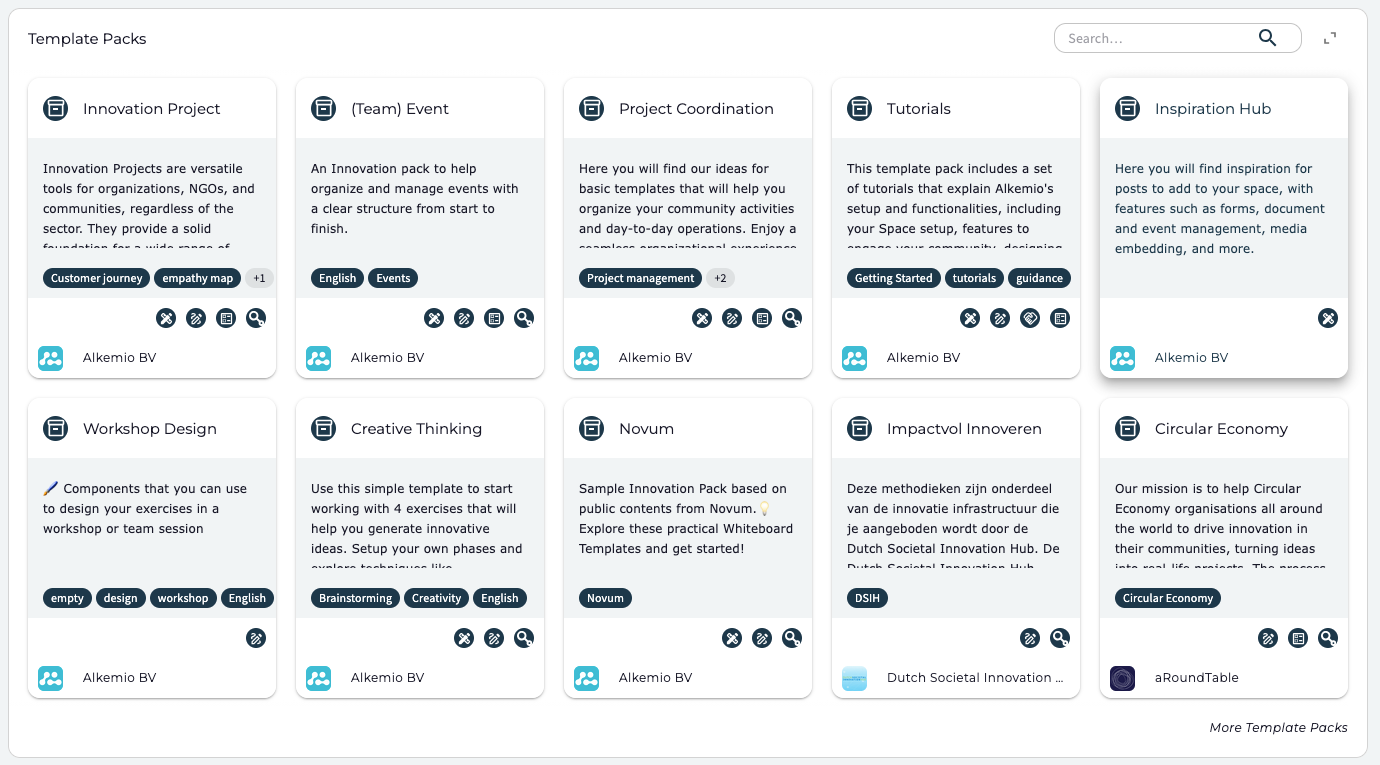
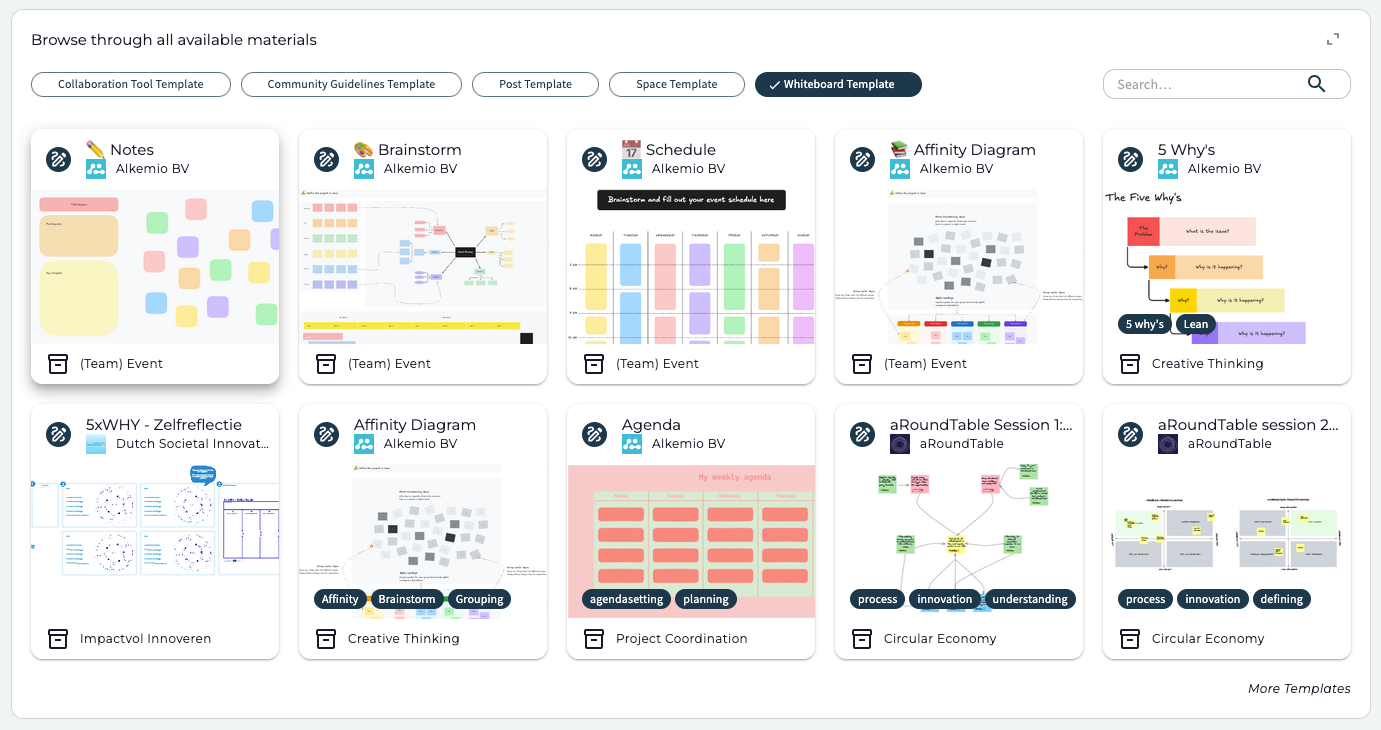
The different kinds of templates available on Alkemio.
Or be inspired and explore real-life examples of how others have structured their collaborations. For example, how the city of The Hague designs and runs its innovation hubs or how the province of South Holland bridges collaboration between government bodies and startups.
In the template library, you will also find methodologies shared by experts and content partners or developed by Alkemio. These methodologies can directly be used as instruments in your Space to facilitate (parts of) the process. They cover approaches like:
- Complete workflows and tools for Design Thinking or hackathons
- Gamestorming tools to spark creativity and alignment
- Agile working templates that help to prioritise work
With templates, your collaboration begins with a solid foundation. This means less time spent on setup and more time to work on collective innovation and creating change!
Stay strong, stay aligned
Traditional tools are not equipped for dynamic, cross-boundary work. That’s why we created a digital environment where processes, roles, and outputs remain visible, structured, and reusable.
Effective collaborations don’t just design workflows once; they capture successful strategies in templates, transforming lessons learned into assets that save time and enhance future initiatives. Our template library facilitates this by allowing you to start with proven structures, adapt them as needed, and replicate successes across projects.
Whether you opt for Alkemio or another platform, consider these critical questions: What does our digital landscape look like? How do we align on next steps and track progress? How can we ensure that all partners know where to find the various workstreams and relevant updates? Can I reuse the existing setup for future projects? Addressing these questions at the outset will help you create a robust digital space that keeps your collaboration aligned, scalable, and focused on achieving a lasting impact.