
From individual expertise to collective wisdom: collaborating based on shared knowledge

Je kunt de Nederlandse versie van deze post hier lezen.
Participants in a collaboration almost always already possess a vast amount of knowledge. They bring experience from past projects, proven methodologies, methods that once worked well, and practical insights. This knowledge already exists within the collaboration. Yet, it’s often inaccessible when it’s needed most.
Much valuable expertise remains scattered across individuals, documents, or past initiatives. It’s stored in people’s minds, loose notes, or completed projects where lessons learned weren’t documented for easy sharing. As a result, collaborations often reinvent what was already known — not because there’s a lack of knowledge, but because there’s no shared space where that knowledge can come together, grow, and be reused.
This presents both a challenge and an opportunity: How can we ensure that acquired and implicit knowledge is explicitly documented and shared in a collective knowledge base? This way, collaborations can learn faster, develop more effectively, and achieve better results.
Reusability as the foundation for collaboration
In a previous blog, we explored the concept of reusability and the role of templates. We explained how the Template Library serves as a starting point where collaborations don’t have to begin from scratch but can build on a solid foundation. Methods and tools can be applied directly as instruments within a collaboration, such as facilitating parts of the process.
The principle is simple:
Effective collaborations base their approaches on proven methods and document successful strategies. This way, lessons from the past are reused, and new knowledge is added to save time and strengthen future initiatives.
The value of a growing collective knowledge base
When knowledge, approaches, and work formats are explicitly documented and made accessible, they become more than just a collection of best practices. They form a collective wisdom that others can build upon, strengthening each other’s work.
The value lies in the fact that this collective knowledge base grows with the community using it. It is continuously enriched with new insights and up-to-date methods, functioning as a living ecosystem of knowledge, tools, and templates. Instead of redesigning every collaboration from scratch, teams can build on what already works. This not only speeds up the process but also improves the quality of outcomes. Templates emphasise proven workflows and avoid less productive approaches, leading to high-quality results.

From siloed knowledge to shared approaches
To truly grow this living ecosystem of knowledge and keep it usable, we unite two sides in a seamless process. On the one hand, it’s about unlocking expertise. Experts and knowledge managers bring proven methods together in the Template Library, making them explicit and reusable as templates. By doing so, we break down silos and create a shared base where lessons from previous projects, documents, and practical experiences come together and are accessible to everyone.
On the other hand, we lower the barrier for the end user. Facilitators and portfolio managers of multi-stakeholder collaborations gain access to a low-threshold starting point with templates they can immediately deploy, test, and adapt to their context, goals, and dynamics. It isn’t a fixed recipe, but a flexible starting point that accelerates collaboration and enables learning.
By uniting these two sides, we create a collective knowledge base where contributions from experts circulate as best practices and where users build on each other’s lessons. This transforms existing knowledge from silos into shared ways of working that effectively support and scale collaboration.
From this perspective, the contributions of experts are highly valuable. Their templates make proven methods concrete and applicable, and help collaborations to create structure or stimulate creativity.
Expertise in the Collective Knowledge Base
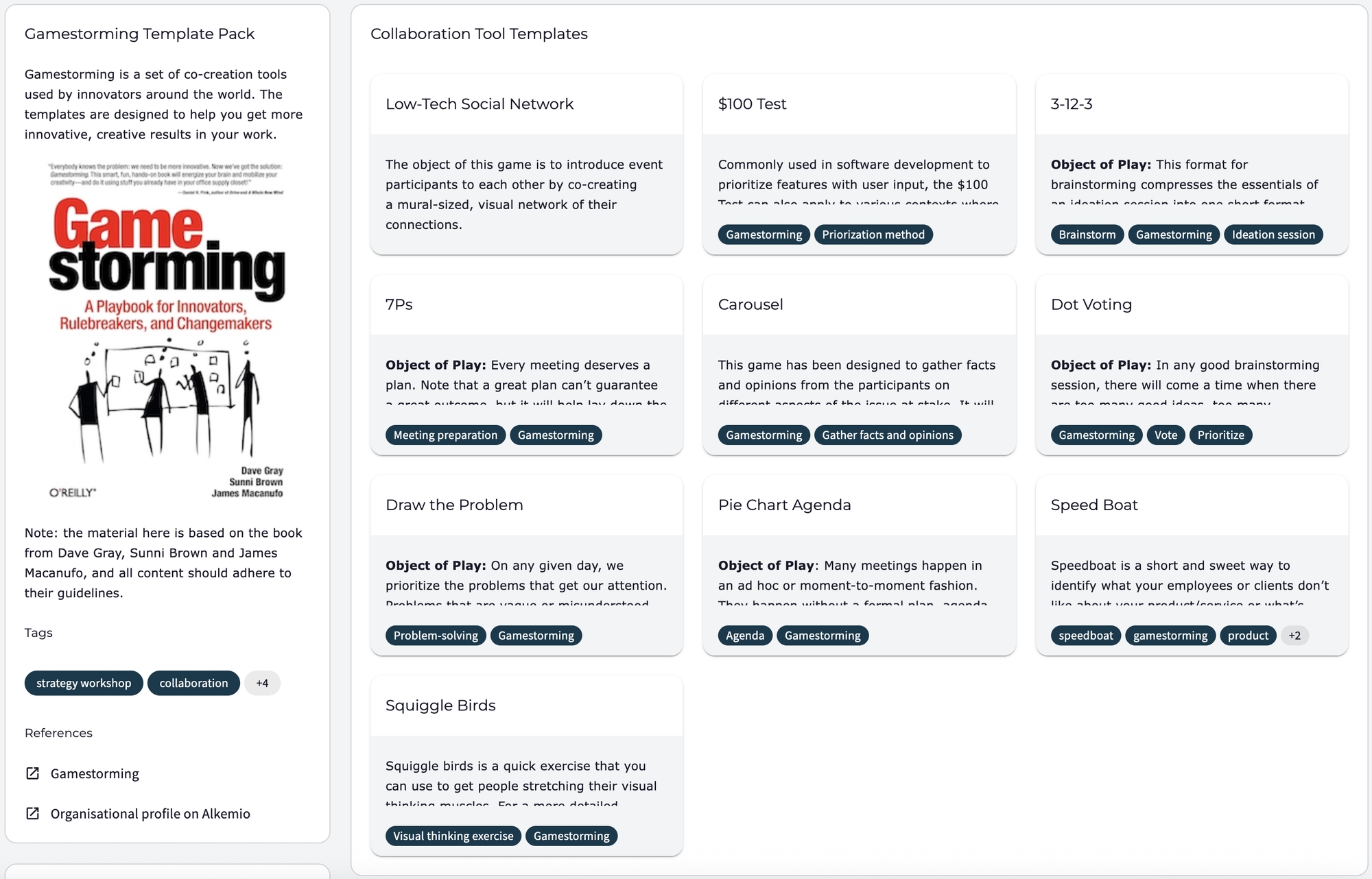
To strengthen this collective knowledge base, we collaborate with various experts who have translated their experience into concrete templates. Two of them are Agile Scrum Group and Gamestorming.
Gamestorming is known for its tools that help teams:
- Explore complex questions together
- Make underlying perspectives and causes visible
- Brainstorm creatively and inclusively for solutions
These templates are highly useful in collaborations where multiple perspectives converge and where engaging everyone is key.
Agile Scrum Group, on the other hand, focuses on bringing structure to collaboration without making it rigid. Their templates support teams in:
- Iterative work
- Transparency and shared ownership
- Continuous learning and improvement
This makes agile methods highly suitable for inter-organisational collaborations, where uncertainty and change are the norm rather than the exception.
Expert Templates in Practice
A great example of how a template helps in practice is the Sprint Backlog from the agile methodology. This template serves as a shared anchor for the team: a visual overview showing what’s being worked on, what’s prioritised, and how the team aims to achieve the sprint goal. Instead of scattered agreements or to-do lists, there’s a single shared view of the work and progress. As tasks move from To Do to Doing to Done, progress becomes tangible, and bottlenecks are quickly identified. Teams see where work gets stuck and can adjust immediately. At the same time, the Sprint Backlog encourages continuous improvement: insights from past sprints are incorporated into the way of working.
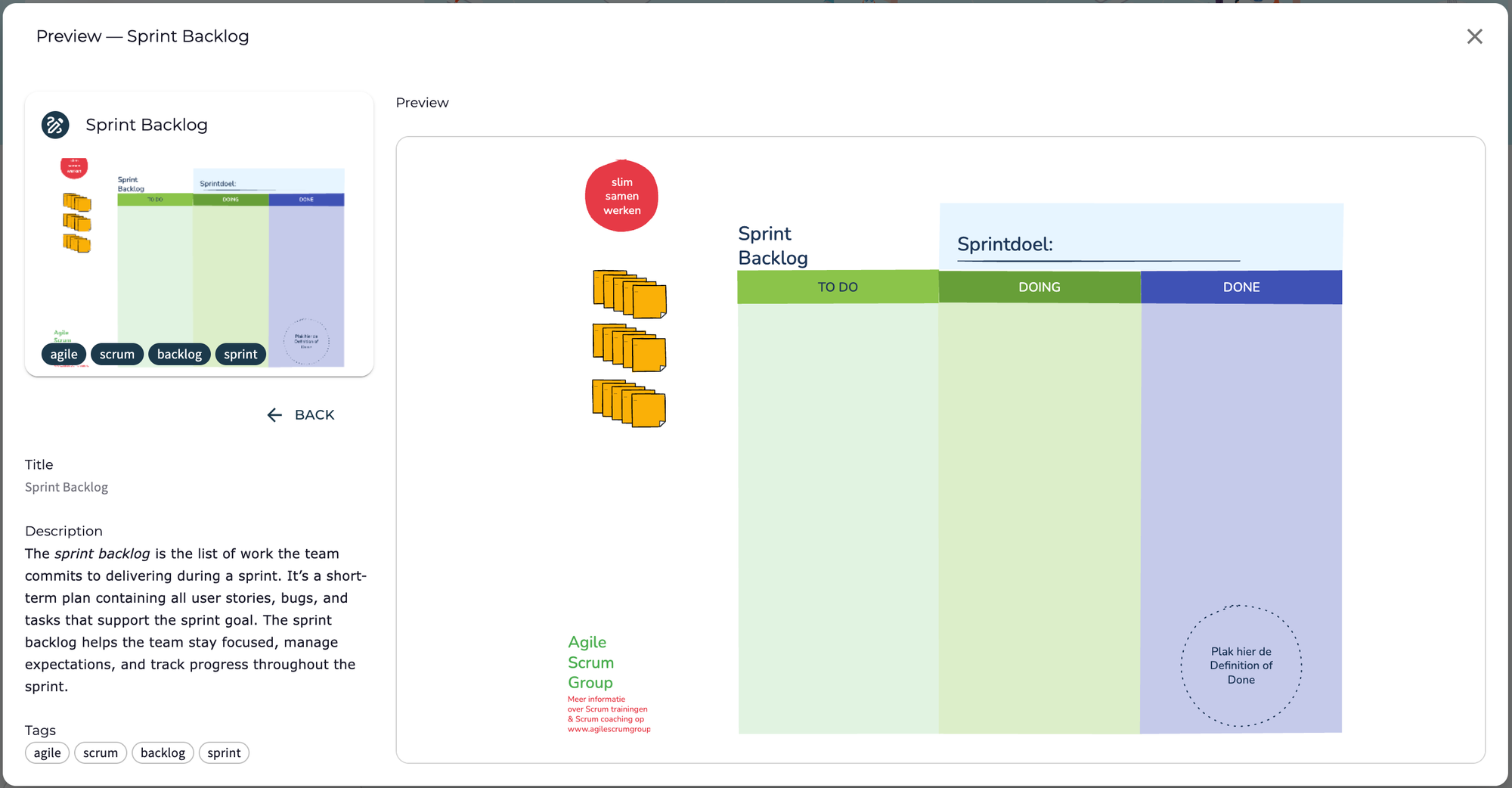
This way, the template provides structure and clarity without losing the flexibility needed in a dynamic work environment. However, it’s important to note that templates like this are not meant to replace specialised project management tools. The latter are indispensable in specific situations, such as large projects with diverse tasks that need precise tracking. In such cases, advanced tools provide the necessary functionality to manage all aspects of the project.
In situations where different activities run in parallel and are part of a larger whole, an integrated template on a single platform adds significant value. It prevents teams from being scattered across multiple tools, leading to inefficiency and fragmented information. By centralising everything in one place, collaboration becomes smoother, and progress is more visible. It’s a matter of context: specialised tools are ideal in certain situations, while in others, templates within an integrated platform add more value.
Partners expand the knowledge base
In addition to templates from Agile Scrum Group and Gamestorming, the Template Library also features contributions from other experts and partners. Design. Think. Make. Break. Repeat offers templates and resources to help teams prototype, test, and refine ideas, making design thinking accessible, practical, and applicable in diverse contexts. Catalyse is a social change agency working with communities and organisations in New Zealand, leveraging its expertise to strengthen collaboration around societal and organisational change.
Ready to get started?
Collaboration becomes more powerful when we build on what’s already proven to work.
Are you already active on the platform and want to strengthen your collaboration?
Check out the expert templates in our Template Library and try one in your next collaboration.
This way, you won’t start from scratch but from a foundation of shared knowledge, taking faster steps toward meaningful change.